
Campus Multiplataforma: A Hub for University Journalism
The contemporary communication landscape is defined by “media convergence” and fragmented platforms, where audiences no longer stay in one place but migrate across Instagram, TikTok, and YouTube. Developed for the University of Brasília’s Journalism Lab, Campus Multiplataforma is a technical response to these challenges. Instead of trying to contain content in a “black box,” it acts as a strategic aggregator hub, facilitating audience navigation through a distributed information flow.
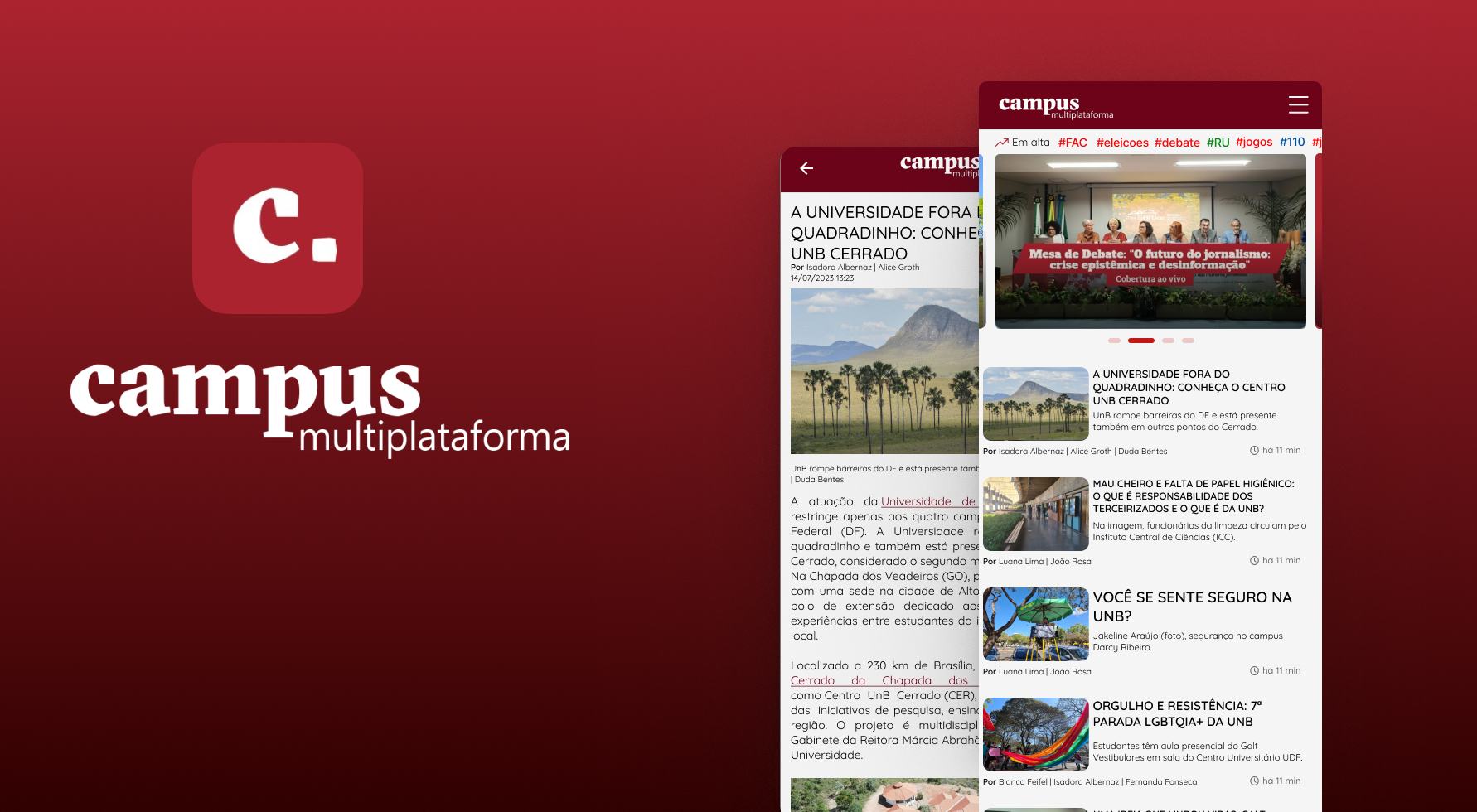
Methodology & Technical Implementation
The project was built using a research-action methodology, merging participant observation with modern software engineering practices.
- Agile Development (Scrum): The work was organized into Sprints, allowing for continuous adaptation and feature re-prioritization based on real newsroom feedback.
- Requirements Engineering: I spent two semesters embedded in the university newsroom, conducting weekly meetings and interviews to validate user stories under the MoSCoW prioritization framework.
- Cross-Platform Architecture: To maximize reach while minimizing costs, I utilized React Native and Expo, enabling a single codebase for both Android and iOS.
- Backend-as-a-Service (BaaS): The app leverages Google Firebase for its infrastructure, providing robust scalability, real-time data management, and secure role-based authentication.
Key Features & Innovation
Beyond being a news reader, the app manifests deep theoretical concepts through practical software features:
- Role-Based Access Control (RBAC): The system mirrors a decentralized newsroom workflow, granting Journalists the autonomy to create and Editors the power to approve or moderate content.
- Multimedia Integration: By consuming APIs from Instagram, TikTok, and YouTube, the app transforms fragmented content into a cohesive journalistic journey.
- Fostering Collective Intelligence: Moving beyond passive consumption, the Story Suggestion (Pautas) feature allows readers to actively initiate the news cycle. As Pierre Lévy proposed, this turns knowledge into a collaborative process co-created with the community.
Impact & Results
Published in April 2025, the application has achieved a 5-star rating on the Google Play Store. It serves as a replicable model for innovation in academic newsrooms, proving that technology can solve the challenges of media convergence through participation and interactivity.
Tech Stack: TypeScript Firebase React Native GCP