
A Reflection on Data Representativeness in Datasets
Published:
Perhaps the biggest difference between studying and working with Artificial Intelligence lies in the data itself. In courses and small-scale projects, datasets are perfect. At most, we perform some exploratory analysis, convert strings to floats, and clean up missing values or outliers. In real life, however, the story has proven to be completely different. Developing a model that performs well and is actually useful for society when dealing with scarce or low-quality data is extremely complicated. T
Through the IEEE Computational Intelligence Society Student Chapter at UnB, I am currently working on building an AI to help reunite lost dogs with their owners. I’ll save the algorithms for another post; right now, I want to talk about the foundation of it all: the data!
When we discuss data quality, we must consider dimensions such as completeness, consistency, timeliness, and, most importantly, relevance—whether the data truly represents the reality of the context where it will be used.
Regarding relevance, I recently came across a paper titled “Does Object Recognition Work for Everyone?” published by Facebook, which became a vital theoretical foundation for my current project. The study compares the accuracy of five object recognition systems using geographically diverse datasets—photos of the same theme but taken in different regions of the world. For instance: if you show a Google, Azure, or Amazon system a photo of a spice rack from the United States, how would it classify it? Now, what if the photo is of a spice rack from the Philippines?
The research shows a significant gap in accuracy across different scenarios. Recognition of household items from locations with an average household income of less than $50/month was 10% less accurate compared to items from locations with incomes above $3,500/month. The analysis indicates that this performance drop is primarily due to the distinct appearance of objects within the same class and the fact that items often appear in different contexts, such as toothbrushes being found outside of a bathroom.
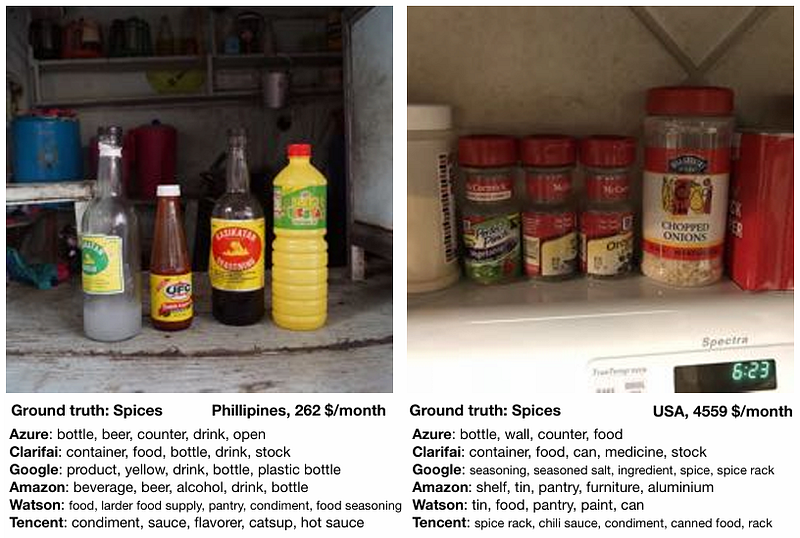
As the study concludes: “The results of our study suggest that further work is needed to make object-recognition systems work equally well for people across different countries and income levels.”
Furthermore, an analysis of the metadata in ImageNet—the massive database used to train cornerstone models like ResNet50, MobileNet, Inception, and YOLOv8—reveals that the data originates mainly from Western Europe, the United States, and Canada. Looking at this critically, we realize that the datasets used for state-of-the-art models are not diverse enough to be representative on a global scale.
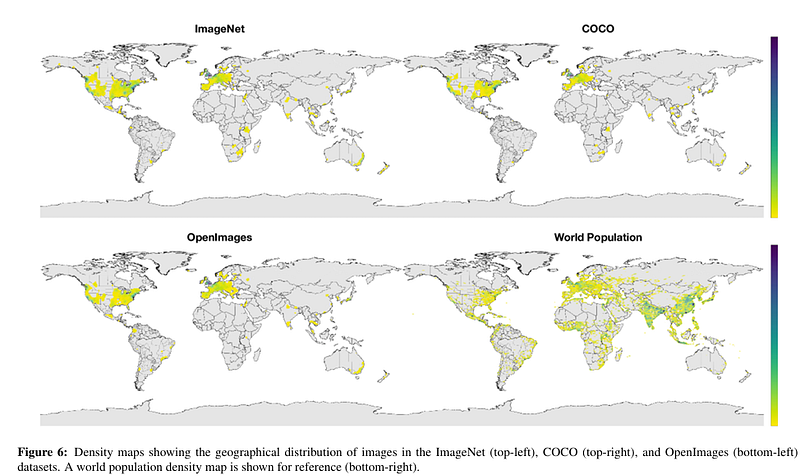
In a context where major datasets are mostly tailored to North American and European realities, a question arises: when should we start building our own databases to represent our own reality? In the “Onde Está Meu Caramelo?” project, we noticed that Brazil has a massive population of mixed-breed dogs, affectionately known as “caramelos” or “fiapos de manga,” while breeds like Huskys are far less common. What would be the impact of relying solely on online datasets for our model’s performance? In a production environment, our model will face images that reflect Brazilian daily life and customs, such as specific grooming styles or accessories given by local pet shops.
If something truly representative doesn’t exist yet, perhaps it is up to us to create it. That is why we are building an image database with the support of the Brazilian community. Our goal is to train models (or at least perform fine-tuning) that can perform with excellence when they encounter truly Brazilian data.